Sunday, 1 February 2015
Unusual Leeds / Yorkshire Medal
Whilst recently waiting for a train at Leeds station, I popped into the Tourist Information Office and bought the medal shown in the photograph. It was very reasonably priced at £1. I understand that they were having some kind of a sale as the Tourist Information Office is due to move to new premises in February, 2015.
The medal is crown sized and came encapsulated as shown. The edge is milled and the obverse depicts the Yorkshire rose whilst the reverse includes the Leeds Owl. No further information about the medal appeared to be available at the Tourist Information Office which is a shame as it would be interesting to know if the medal is part of a collection for the Yorkshire cities.
Tuesday, 21 October 2014
Did Sherlock Holmes have even the most elementary knowledge of Horsham?
My former home town of Horsham is featured in the Sherlock Holmes story “The Five Orange Pips”. Surprisingly, in this story, the illustrious detective proves that he is not too well read about the town.
The story largely centres around the murders of members of the Openshaw family. John Openshaw visits Holmes on a stormy night in September, 1887, to seek advice concerning these events. In view of the opening comments from the detective, I am a little surprised that Openshaw stayed for very long. Holmes remarks at the start of the conversation,“You have come up from the south-west, I see." Openshaw replies with “Yes, from Horsham”. This, of course, immediately struck me as strange as Horsham is situated due south of London and is most definitely in the south-east and not the south-west.
Sherlock Holmes then comments that the “clay and chalk mixture which I see upon your toe caps is quite distinctive”. As someone who spent their childhood in Horsham I can say that I never encountered chalky soils in all my misadventures spent digging holes and playing on building sites. Openshaw, to his credit, does not make a direct reply to this comment. He was probably beginning to wonder why he had travelled up from Sussex on a wild and rainy night to listen to such drivel. In view of the weather, it also seems probable that all muddy deposits would have been washed from Openshaw's shoes long before he reached 221B Baker Street.
At the conclusion of the interview, Openshaw departs to catch the train from Waterloo to Horsham. This turns out to be a disastrous decision as he is murdered on his way to the station. If he had succeeded in reaching Waterloo, he may have been disappointed to find that there were no direct trains to Horsham. The line from Waterloo to Horsham runs via Dorking and then through the Betchworth tunnel. Unfortunately, records show that the Betchworth tunnel collapsed on the 27th July, 1887, and remained shut for over six months. It would, thus, not have been possible for Openshaw to make his journey in September of that year without a number of changes of train. It is more than surprising that neither Holmes nor his client seem to be aware of this event.
Sherlock Holmes does not visit Horsham during the course of his investigations and eventually succeeds in identifying the murderers from inquiries made in London. This is perhaps a shame as he obviously could have learnt a lot from even the shortest of visits.
Sunday, 23 March 2014
Walking from Haltwhistle to Alston along the South Tyne Trail
I have always been interested in disused railway walks and was delighted to find that it was possible to walk between Haltwhistle and Alston almost entirely along the former line between the two towns. In fact, the only sections not along the original route are in the area of the Haltwhistle bypass and around the station at Lambley. Taking advantage of the relatively good weather on Friday, 21st March, 2014, I walked the fourteen miles between the two towns along the South Tyne Trail.
The first part of the route is entirely on well metalled footpaths with easy gradients. Some good views are to be had of the Alston arches immediately upon leaving Haltwhistle. After a few miles, Lambley viaduct is reached. Some steep paths have to be negotiated as the route avoids the privately owned Lambley station. Fortunately, it is possible to walk over the viaduct and some spectacular views are to be had of the river and the viaduct itself as shown below.
Beyond Lambley, the path is mainly of gravel construction but makes for easy walking. The old platform is still visible at Coanwood station. A substantial pair of buffers are also still sited there.
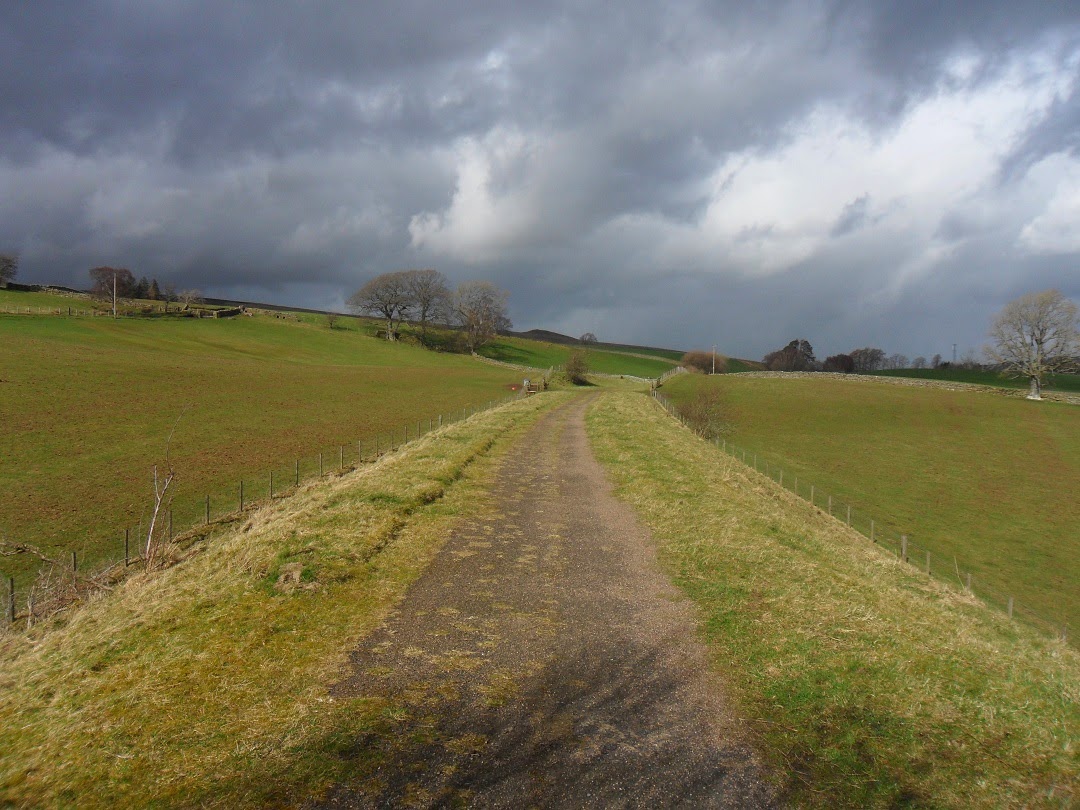
The countryside is a mixture of moorland and woods until Slaggyford is reached. A typical view of the countryside along the trail is shown below:
The largest settlement on the route is Slaggyford. Whilst there do not appear to be any services for walkers in the village, the station is quite well preserved and worth stopping at for a few minutes. The station building on the left of the photograph below is showing decided signs of having seen better days but presumably will be renovated once the South Tyne Dale railway reaches Slaggyford in the next few years.
The cycle trail turns off the railway line just south of Slaggyford and it soon becomes apparent that there is a good reason for this. The footpath is very boggy for about a mile and makes for hard going and wet boots. Considerable drainage works will be required before the railway can be reinstated in this area. Thankfully, the boggy section does not continue for too long and a firm footpath is reached before the point that the narrow gauge railway starts just north of Lintley Halt. The slightly unexpected start of the railway is shown below:
The firm footpath continues from Lintley Halt alongside the railway to the terminus at the wonderfully preserved Alston station.
The walk took me five hours at a moderate pace with a couple of breaks for sandwiches and coffee. Admittedly I did the walk in March but I only saw six other walkers and no cyclists over the entire day. I would certainly recommend the trail as a pleasant and relatively easy walk through stunning moorland scenery. If you also have an interest in railway architecture, you are in for a memorable and enjoyable day.
The first part of the route is entirely on well metalled footpaths with easy gradients. Some good views are to be had of the Alston arches immediately upon leaving Haltwhistle. After a few miles, Lambley viaduct is reached. Some steep paths have to be negotiated as the route avoids the privately owned Lambley station. Fortunately, it is possible to walk over the viaduct and some spectacular views are to be had of the river and the viaduct itself as shown below.
Beyond Lambley, the path is mainly of gravel construction but makes for easy walking. The old platform is still visible at Coanwood station. A substantial pair of buffers are also still sited there.
The countryside is a mixture of moorland and woods until Slaggyford is reached. A typical view of the countryside along the trail is shown below:
The largest settlement on the route is Slaggyford. Whilst there do not appear to be any services for walkers in the village, the station is quite well preserved and worth stopping at for a few minutes. The station building on the left of the photograph below is showing decided signs of having seen better days but presumably will be renovated once the South Tyne Dale railway reaches Slaggyford in the next few years.
The cycle trail turns off the railway line just south of Slaggyford and it soon becomes apparent that there is a good reason for this. The footpath is very boggy for about a mile and makes for hard going and wet boots. Considerable drainage works will be required before the railway can be reinstated in this area. Thankfully, the boggy section does not continue for too long and a firm footpath is reached before the point that the narrow gauge railway starts just north of Lintley Halt. The slightly unexpected start of the railway is shown below:
The firm footpath continues from Lintley Halt alongside the railway to the terminus at the wonderfully preserved Alston station.
The walk took me five hours at a moderate pace with a couple of breaks for sandwiches and coffee. Admittedly I did the walk in March but I only saw six other walkers and no cyclists over the entire day. I would certainly recommend the trail as a pleasant and relatively easy walk through stunning moorland scenery. If you also have an interest in railway architecture, you are in for a memorable and enjoyable day.
Sunday, 17 November 2013
A final view of Don Valley Stadium, 16th November, 2013
As I was in Attercliffe, I decided to take a couple of photographs of the ill fated stadium just before its demolition which is due to commence before the end of November, 2013. The above photograph was taken from near the cauldron which Helen Sharman so spectacularly failed to light as planned at the start of the World Student Games in 1991. The trees in the foreground, perhaps, give an exaggerated appearance of neglect to the stadium. Nevertheless, it is safe to say that the stadium was never used in the way that had been hoped.
I only visited the venue once in its 22 year life and that was to see the Sheffield Eagles rugby league team play against Oldham in 1990. As I recall, the Eagles lost in front of a modest crowd who were seated in just one of the stands. The distance from the seating to the pitch also made for a dispiriting atmosphere. I did not go back for more. Unfortunately, neither did many others.
The cauldron looks quite neglected and scarred. The area at the back of the stadium, in general, is overgrown and neglected.
In a sporting city, it is sad that the Don Valley Stadium did not become a successful venue. I, still, can't help but wonder whether demolition is the best answer. The demolition costs will be expensive and there will be no future home in the city if one of the local sporting teams need temporary accommodation because of ground redevelopment works.
As a final thought, I wonder how long it will take for the Passenger Transport Executive to replace the signing at the nearby Supertram stop?
Tuesday, 29 October 2013
Did Sherlock Holmes have even the most elementary knowledge of Horsham?
My former home town of Horsham is featured in the Sherlock Holmes story “The Five Orange Pips”. Surprisingly, in this story, the illustrious detective proves that he is not too well read about the town.
The story largely centres around the
murders of members of the Openshaw family. John Openshaw visits
Holmes on a stormy night in September, 1887, to seek advice
concerning these events. In view of the opening comments from the
detective, I am a little surprised that Openshaw stayed for very
long. Holmes remarks at the start of the conversation,“You have
come up from the south-west, I see." Openshaw replies with
“Yes, from Horsham”. This, of course, immediately struck me as
strange as Horsham is situated due south of London and is most
definitely in the south-east and not the south-west.
Sherlock Holmes then comments that the
“clay and chalk mixture which I see upon your toe caps is quite
distinctive”. As someone who spent their childhood in Horsham I
can say that I never encountered chalky soils in all my misadventures
spent digging holes and playing on building sites. Openshaw, to his
credit, does not make a direct reply to this comment. He was
probably beginning to wonder why he had travelled up from Sussex on a
wild and rainy night to listen to such drivel. In view of the
weather, it also seems probable that all muddy deposits would have
been washed from Openshaw's shoes long before he reached 221B Baker
Street.
At the conclusion of the interview, Openshaw departs to catch the train from Waterloo to Horsham. This turns out to be a disastrous decision as he is murdered on his way to the station. If he had succeeded in reaching Waterloo, he may have been disappointed to find that there were no direct trains to Horsham. The line from Waterloo to Horsham runs via Dorking and then through the Betchworth tunnel. Unfortunately, records show that the Betchworth tunnel collapsed on the 27th July, 1887, and remained shut for over six months. It would, thus, not have been possible for Openshaw to make his journey in September of that year without a number of changes of train. It is more than surprising that neither Holmes nor his client seem to be aware of this event.
Sherlock Holmes does not visit Horsham during the course of his investigations and eventually succeeds in identifying the murderers from inquiries made in London. This is perhaps a shame as he obviously could have learnt a lot from even the shortest of visits.
Labels:
Betchworth tunnel,
five orange pips,
horsham,
Sherlock Holmes
Sunday, 22 September 2013
A Lucky Rouble!
Many in England will be familiar with the idea of a lucky sixpence. A few may remember searching for them in Christmas puddings though the original tradition was that silver threepences were the additional ingredient of many a Yuletide dessert. Brides also used to put sixpences in their shoes for luck on their wedding days. I suppose it should not come as too much of a surprise to find that other countries also have such traditions relating to coinage.
I came across the lucky rouble whilst walking along Kreschatik in Kiev during the Independence Day celebrations on the 24th August. One enterprising individual was striking these novelty coins on the spot for sale to the many passers by. Having more than a passing interest in coinage, I decided to acquire one.
Upon enquiry, I soon discovered that the purchaser was not too lucky in terms of the price of the rouble. Each coin retailed at 35 Ukrainian Hryvnas which equates approximately to 3 British pounds or 4.5 US dollars. One lucky rouble, thus, cost about 150 real Russian roubles!
The coin itself, as I have said, was struck at the stall in front of the customer so if you like your novelty coins fresh, Kiev on Independence Day is the place to go. The inscription in Russian (1 счастливый рубль) translates as one lucky rouble. The reverse of the coin depicts a horseshoe to signify good luck. Unsurprisingly for a hand struck item, the edge is not milled and bears no inscription. The coin is approximately 20mm in diameter.
Has the lucky rouble brought me any luck? Well, since its acquisition, nothing terrible has happened so its power to date cannot be denied.
Sunday, 19 May 2013
"The Brown Hand" by Arthur Conan Doyle reviewed in a very different age
"The Brown Hand" is one of Conan Doyle's lesser known short stories but it has a number of interesting features especially when read over 100 years from the time of its production. The story reflects Conan Doyle's interest in psychic matters and gives us an insight into Victorian attitudes to race and class whilst still being an interesting tale in its own right.
Briefly, the story revolves around how the narrator, Dr Hardacre, inherits the fortune of a former surgeon in the Indian army, Sir Dominick Holden, by solving the mystery of why a dead Indian man is haunting Sir Dominick with nocturnal visits. Dr Hardacre is just one of many relatives invited to the former surgeon's home after Sir Dominick's return home to Wiltshire from service in India. The conversation between the two turns to psychic matters and the surgeon invites Dr Hardacre to spend the night in his laboratory which the unhappy spirit visits every night to inspect the surgeon's collection of anatomical specimens. Sir Dominick mentions that the collection of specimens is incomplete as a result of some being lost in a house fire which occured many years previously. Dr Hardacre accepts the invitation and duly sees the apparition of a one handed man present in the laboratory during the night. Sir Dominick confirms that the spirit is that of an Indian on whom he had carried out an amputation in the past. He had promised to keep the hand in his collection until the man died and his spirit returned for it to enable its future progression. Unfortunately, the hand was one of the specimens lost in the house fire. The spirit of the man had been haunting the surgeon as he searched for his lost hand. Hardacre accepts the challenge of solving the problem and goes off in search of a similar specimen to replace the lost hand and hence propitiate the spirit. Eventually, a satisfactory example is left in the laboratory overnight and the spirit accepts the replacement. Sir Dominick is haunted no more and, in gratitude, duly leaves his fortune to Hardacre, much to the chagrin of other better placed relatives.
The story is based upon the belief among certain cultures that the body must be complete after death. In this particular instance, it is assumed that "a reasonable compromise" can be effected if it is not possible to reunite the lost hand with its original owner. It is curious that Conan Doyle assumes that any brown hand would be a reasonable compromise which would pacify the unhappy spirit. No mention is made of any other similarity between the lost hand and its replacement other than its colour. This could be, inadvertently, telling of attitudes in the age in which the story was written.
The first attempt to provide the spirit with a replacement hand is unsuccessful. This failure can be anticipated by most readers as no mention is made of whether a right or left hand is offered as a substitute on the first occasion. The author's attempt to keep up the suspense by the use of this device is not altogether a success.
The narrator is clearly very impressed with the Wiltshire scenery as he makes his journey to the surgeons's house. There are some evocative descriptions of the barrows and tumuli dotted around the Wiltshire countryside. The author compares the magnificence of the prehistoric remains with the small cottages of the local inhabitants. The occupiers of these dwellings are described as "peasants".
There is a particularly interesting description of the pillars at the entrance to Sir Dominick's country estate. It would appear that, even in the 19th century, these columns, so often adorned with heraldic devices, were looking weather worn and tired. Many of these pillars can still be seen today in the countryside across England. The world of the British Empire may have long since passed but these monuments remain as a reminder of a bygone age.
Briefly, the story revolves around how the narrator, Dr Hardacre, inherits the fortune of a former surgeon in the Indian army, Sir Dominick Holden, by solving the mystery of why a dead Indian man is haunting Sir Dominick with nocturnal visits. Dr Hardacre is just one of many relatives invited to the former surgeon's home after Sir Dominick's return home to Wiltshire from service in India. The conversation between the two turns to psychic matters and the surgeon invites Dr Hardacre to spend the night in his laboratory which the unhappy spirit visits every night to inspect the surgeon's collection of anatomical specimens. Sir Dominick mentions that the collection of specimens is incomplete as a result of some being lost in a house fire which occured many years previously. Dr Hardacre accepts the invitation and duly sees the apparition of a one handed man present in the laboratory during the night. Sir Dominick confirms that the spirit is that of an Indian on whom he had carried out an amputation in the past. He had promised to keep the hand in his collection until the man died and his spirit returned for it to enable its future progression. Unfortunately, the hand was one of the specimens lost in the house fire. The spirit of the man had been haunting the surgeon as he searched for his lost hand. Hardacre accepts the challenge of solving the problem and goes off in search of a similar specimen to replace the lost hand and hence propitiate the spirit. Eventually, a satisfactory example is left in the laboratory overnight and the spirit accepts the replacement. Sir Dominick is haunted no more and, in gratitude, duly leaves his fortune to Hardacre, much to the chagrin of other better placed relatives.
The story is based upon the belief among certain cultures that the body must be complete after death. In this particular instance, it is assumed that "a reasonable compromise" can be effected if it is not possible to reunite the lost hand with its original owner. It is curious that Conan Doyle assumes that any brown hand would be a reasonable compromise which would pacify the unhappy spirit. No mention is made of any other similarity between the lost hand and its replacement other than its colour. This could be, inadvertently, telling of attitudes in the age in which the story was written.
The first attempt to provide the spirit with a replacement hand is unsuccessful. This failure can be anticipated by most readers as no mention is made of whether a right or left hand is offered as a substitute on the first occasion. The author's attempt to keep up the suspense by the use of this device is not altogether a success.
The narrator is clearly very impressed with the Wiltshire scenery as he makes his journey to the surgeons's house. There are some evocative descriptions of the barrows and tumuli dotted around the Wiltshire countryside. The author compares the magnificence of the prehistoric remains with the small cottages of the local inhabitants. The occupiers of these dwellings are described as "peasants".
There is a particularly interesting description of the pillars at the entrance to Sir Dominick's country estate. It would appear that, even in the 19th century, these columns, so often adorned with heraldic devices, were looking weather worn and tired. Many of these pillars can still be seen today in the countryside across England. The world of the British Empire may have long since passed but these monuments remain as a reminder of a bygone age.
Subscribe to:
Posts (Atom)