Tuesday, 9 April 2013
The 60 bus to Crimicar Lane remembered
Upon my arrival in Sheffield as a student in the autumn of 1981, I was lucky enough to live, like so many students, in the beautiful Ranmoor area of the City. Apart from the delights of the Ranmoor Tavern and the Rising Sun, the area was also well served by the No 60 bus.
The No 60 was unusual at the time as it was a one man operated service at a time when most Sheffield buses still had conductors. This, of course, slowed the service down somewhat especially as the many students who lived in the area were unfamiliar with the fare structure and the destinations. Nevertheless, the service was very reliable and was particularly useful as it served the railway station, the polytechnic and the bus station as well as going through the centre of town.
In 1981, Sheffield had a low fares policy and the journey from Nether Green to town cost only eight pence. I was once told that it cost more to collect the fares than the amount that was made from the sale of tickets. I cannot confirm this but it would not surprise me. Unfortunately, the cheap fares policy came to an end a few years later when London Transport tried the same idea and incurred the displeasure of the government.
The No 60 bus normally terminated at Crimicar Lane but some journeys ended at Broomhill, Ranmoor and Nether Green. Many users will recall having to check the bus's destination board before getting on. The picture above shows a Crimicar Lane bound service pulling up Fulwood Road from the Rising Sun in the autumn of 1981.
Some of the buses were fitted with a sound system on the top deck. Passengers were entertained by a broadcast entitled "Sounds in Motion". Unfortunately, there did not seem to be many tapes in the Sounds In Motion repertoire. I lost count of the number of times I heard "It sure brings out the love in your eyes" by David Soul and "Emotion" by Samantha Sang.
The No 60 bus eventually passed into history and was replaced by the number 40 and then by the current No 120. The route has changed a little and the current service does not pass the railway station or terminate at the bus station.
Sunday, 24 March 2013
A review of "Miss Arnott's Marriage" by Richard Marsh
"Miss Arnott's Marriage" is one of the much under-rated Richard Marsh's long stories. The plot revolves around the events which occur after Violet Arnott's husband, Bob Champion (not the Grand National winner, obviously!) is sent to prison. Violet decides to revert to her maiden name and forget about her wayward spouse. Initially, her task seems to be made easier as she comes into a large sum of money. She quickly leaves London and her troubles behind her and takes up residence at Exley Park. At Exley, she attracts the romantic attention of Hugh Morice who owns the adjoining estate. Mr Morice's suit is met largely with scorn by Miss Arnott but events will eventually change that...
The critical moment of the story is reached when Bob Champion, after his release from prison, tracks his erstwhile wife down at Exley Park. Violet confronts Bob at a remote spot, one evening, and informs him that she wants nothing more to do with him. She leaves him in rude good health and sets off back for the house. Bob comes to an untimely end soon after. A shot is heard and Violet sees Mr Morice running away near the scene of the crime. The estate's gamekeeper, Jim Baker, is also abroad that night and he is known to hold grudges and be somewhat trigger happy after a few drinks. The behaviour of Miss Arnott's companion, Mrs Plummer, also seems a trifle odd. The police investigate with only limited success and it is left to others to find the guilty party and release the innocent from real prisons or those of their own minds. The final denouement is dramatic and unexpected. I will not spoil it by describing it here.
One of Richard Marsh's many strengths as a writer was his ability to outline his female characters as well as their male counterparts. Women are the central characters in a number of his books including "Violet Forster's Lover" and most notably in "A Duel". Miss Arnott does not seem a particularly likeable character at the outset of the story but the reader's sympathy grows as the tale unfolds.
Most of Richard Marsh's books hook the reader from almost the first page and the tempo of the story is kept up. "Miss Arnott's Marriage" is somewhat different in that the story builds from a slow beginning to a crescendo. In many of Marsh's books, the ending sometimes seems a little weak and almost added as something of an after thought. The train crash which sees the destruction of the Beetle in the book of the same name is perhaps an example. There is certainly no lack of tension in"Miss Arnott's Marriage" as the murderer is revealed.
Many of Richard Marsh's books rely on almost unbelievable coincidences to make the plots work. In "The Crime and the Criminal" as an example, a long separated man and wife happen to find themselves alone many years later in a railway carriage travelling from Brighton to London which leads to a tragedy at Three Bridges. Near the end of "Miss Arnott's Marriage", it becomes apparent that Bob Champion has had relations with another resident of Exley park in the dim, distant and seemingly unrelated past.
"Miss Arnott's Marriage" describes a bygone world in an entertaining manner. The motor car was just beginning to become a plaything of the upper classes and the world of chamber maids, butlers and game keepers still existed.
Whilst I would not say "Miss Arnott's Marriage" was the best or most amusing of Richard Marsh's books, it is certainly worth reading. It can be found on project Gutenberg at http://www.gutenberg.org/ebooks/37963
I understand that Crawley Library are planning a Richard Marsh exhibition in the summer. More information about this event can be obtained by contacting the library. It is a shame that I am based 200 miles away in Sheffield. I would have liked to have seen what they have uncovered about this great author.
The critical moment of the story is reached when Bob Champion, after his release from prison, tracks his erstwhile wife down at Exley Park. Violet confronts Bob at a remote spot, one evening, and informs him that she wants nothing more to do with him. She leaves him in rude good health and sets off back for the house. Bob comes to an untimely end soon after. A shot is heard and Violet sees Mr Morice running away near the scene of the crime. The estate's gamekeeper, Jim Baker, is also abroad that night and he is known to hold grudges and be somewhat trigger happy after a few drinks. The behaviour of Miss Arnott's companion, Mrs Plummer, also seems a trifle odd. The police investigate with only limited success and it is left to others to find the guilty party and release the innocent from real prisons or those of their own minds. The final denouement is dramatic and unexpected. I will not spoil it by describing it here.
One of Richard Marsh's many strengths as a writer was his ability to outline his female characters as well as their male counterparts. Women are the central characters in a number of his books including "Violet Forster's Lover" and most notably in "A Duel". Miss Arnott does not seem a particularly likeable character at the outset of the story but the reader's sympathy grows as the tale unfolds.
Most of Richard Marsh's books hook the reader from almost the first page and the tempo of the story is kept up. "Miss Arnott's Marriage" is somewhat different in that the story builds from a slow beginning to a crescendo. In many of Marsh's books, the ending sometimes seems a little weak and almost added as something of an after thought. The train crash which sees the destruction of the Beetle in the book of the same name is perhaps an example. There is certainly no lack of tension in"Miss Arnott's Marriage" as the murderer is revealed.
Many of Richard Marsh's books rely on almost unbelievable coincidences to make the plots work. In "The Crime and the Criminal" as an example, a long separated man and wife happen to find themselves alone many years later in a railway carriage travelling from Brighton to London which leads to a tragedy at Three Bridges. Near the end of "Miss Arnott's Marriage", it becomes apparent that Bob Champion has had relations with another resident of Exley park in the dim, distant and seemingly unrelated past.
"Miss Arnott's Marriage" describes a bygone world in an entertaining manner. The motor car was just beginning to become a plaything of the upper classes and the world of chamber maids, butlers and game keepers still existed.
Whilst I would not say "Miss Arnott's Marriage" was the best or most amusing of Richard Marsh's books, it is certainly worth reading. It can be found on project Gutenberg at http://www.gutenberg.org/ebooks/37963
I understand that Crawley Library are planning a Richard Marsh exhibition in the summer. More information about this event can be obtained by contacting the library. It is a shame that I am based 200 miles away in Sheffield. I would have liked to have seen what they have uncovered about this great author.
Tuesday, 22 January 2013
Newcastle 0 Brighton 2, FA Cup, 1986, remembered
In 1986, Albion were also drawn against Newcastle in the third round of the competition. Then as now, Newcastle were in the top flight and Albion were in the upper half of the second tier of English football. Newcastle could boast players of the calibre of Peter Beardsley and Paul Gascoigne. Albion's outstanding player at that time was Dean Saunders.
The game was played on a very cold Saturday, 4th January. Snow lay on the ground and I feared a postponement as I made the long journey up north to Tyneside. Fortunately, my fears were misplaced and the game kicked off as scheduled. Albion did not have a large following that day but the fans were in good voice and soon they had every reason to be happy with their team's performance.
The opening goal was netted in the first half from short range by Eric Young. The photograph above was taken shortly after the goal was scored. For most of the remainder of the match, Newcastle seemed to be constantly besieging the Brighton goal. I lost count of the number of corners that Newcastle won. Nevertheless, Brighton seemed to be coping well with the pressure and after a while I began to think that the Seagulls would return to Sussex with a win. This belief was confirmed near the end of the game when Dean Saunders collected the ball on the left side and beat the goalkeeper with a fine effort from outside of the penalty area. The last few minutes of the game were played out without any serious scares and the final whistle was greeted by Albion's players and fans with jubilation.
The win at Newcastle was the launching pad for a fine cup run. Albion played the away cup games in an all red "lucky" strip that season. Hull were dispatched 3-2 in an exciting game at Boothferry Park in the 4th round with Terry Connor bagging a brace and Dean Saunders scoring Albion's other goal. The 5th round match at Peterborough was another game played in the snow. A 2-2 draw was fought out in abysmal conditions and the Seagulls triumphed 2-1 in the replay at the Goldstone. The end came in the quarter final at home against Southampton. It was sad that such a great run should come to an end against one of the old enemies but I still have happy memories of that spring when for a while it looked that the Seagulls could repeat the heroics of '83 and possibly even go one step further.
Labels:
1986,
Brighton and Hove Albion,
FA Cup,
Newcastle,
Seagulls
Monday, 21 January 2013
A Victorian comedy reviewed: "Aunt Jane's Jalap" by Richard Marsh
Richard Marsh is mainly remembered, today, for his gothic horror novel, “The Beatle“. However, he wrote many entertaining short stories in addition to his longer more surreal tales. One of my favourites is “Aunt Jane’s Jalap”.
I have to admit that when I began reading this story I would not have known a jalap if it had slapped me round the face, bowed and formally introduced itself. A quick perusal of the Oxford dictionary informed me that a jalap was a purgative made from a Mexican vine of the genus Ipomoea purga. So there you are. I am a little better informed about the flora of central America than before I started to read the book.
Quack medicines, of course, were very popular in the Victorian age. There were virtually no controls on the claims that could be made for “medicines” of even the most dubious provenance. Into this questionable market, Mr Hughes and the narrator, George Lucas, decide to launch their own restorative, “Aunt Jane’s Jalap”.
The name, “Aunt Jane’s Jalap” was dreamt up by our two would be entrepreneurs. Hughes decided to use the name of his old nurse as such a title was likely to be trusted by elderly nineteenth ladies. It was questionable if anyone would buy a product bearing the name of the gentlemen to whom we are introduced.
Mr Hughes and Mr Lucas decide they need testimonials for their new cure-all. They decide to introduce “Aunt Jane’s Jalap” at a dinner party to be held with George’s lady friend, Margaret, her aunt Mrs Chalmers and a mutual friend, Mr Pybus. Pybus rapidly proves himself a most sarcastic character and a good judge of the merits of the new concoction.
During the course of the dinner, George raises the subject of the jalap and its supposed virtues. Pybus makes a series of entertaining and disparaging comments about the effectiveness of the remedy. After a while, a bottle of the jalap is produced and measures poured for the four people present. Despite the serious reservations of Mrs Chalmers and Mr Pybus, a full glassful is imbibed by all. The effects are immediate and unfortunate for the assembled party as discomfort and illness rapidly take hold.
The unpleasant effects of drinking the jalap rapidly become more pronounced. George asks Mrs Chalmers if there is anything he can do for her in her discomfort. Pybus mischievously suggests that he fetches another bottle of the remedy.
At this unfortunate juncture, Hughes re-enters the story. He accosts George and informs him that he may have given him a bottle of laudanum by mistake instead of the jalap. Both become very alarmed, as one might expect, at the prospect of a wine glass of poison being quaffed by everyone present. Doctors are called and in the meantime George tries to get the ladies to dance to maintain their circulation and to keep their spirits up. This ruse meets with only limited success.
Various doctors make their appearance and after adding to the comedy, they eventually cure the patients. George coolly observes that the servant charged with seeking a doctor had “fetched as many as he could. There were not one or two, but several. I have their bills.”
At the end of the story, the doctors inspect the offending bottle and rapidly notice that it does not smell of laudanum. Hughes realises that he has made another mistake and has inflicted a horrendous regime of Victorian treatment on everyone for no reason at all. The bottle did contain jalap but it was one of Hughes’s incorrectly measured test samples of jalap rather than the final product that he had given to George by mistake.
There is no record of whether the assembled party gives “Aunt Jane’s Jalap” a positive testimonial but it would seem unlikely.
I have attempted to outline the main details of the story in this article but have probably failed to convey the humour that Richard Marsh manages to write into the tale. I would thoroughly recommend “Aunt Jane’s Delap” as an entertaining short story written by a very underrated author. The tale is one of a collection of stories entitled “Amusement Only” and can be found on Project Gutenberg at http://www.gutenberg.org/ebooks/38188
I have to admit that when I began reading this story I would not have known a jalap if it had slapped me round the face, bowed and formally introduced itself. A quick perusal of the Oxford dictionary informed me that a jalap was a purgative made from a Mexican vine of the genus Ipomoea purga. So there you are. I am a little better informed about the flora of central America than before I started to read the book.
Quack medicines, of course, were very popular in the Victorian age. There were virtually no controls on the claims that could be made for “medicines” of even the most dubious provenance. Into this questionable market, Mr Hughes and the narrator, George Lucas, decide to launch their own restorative, “Aunt Jane’s Jalap”.
The name, “Aunt Jane’s Jalap” was dreamt up by our two would be entrepreneurs. Hughes decided to use the name of his old nurse as such a title was likely to be trusted by elderly nineteenth ladies. It was questionable if anyone would buy a product bearing the name of the gentlemen to whom we are introduced.
Mr Hughes and Mr Lucas decide they need testimonials for their new cure-all. They decide to introduce “Aunt Jane’s Jalap” at a dinner party to be held with George’s lady friend, Margaret, her aunt Mrs Chalmers and a mutual friend, Mr Pybus. Pybus rapidly proves himself a most sarcastic character and a good judge of the merits of the new concoction.
During the course of the dinner, George raises the subject of the jalap and its supposed virtues. Pybus makes a series of entertaining and disparaging comments about the effectiveness of the remedy. After a while, a bottle of the jalap is produced and measures poured for the four people present. Despite the serious reservations of Mrs Chalmers and Mr Pybus, a full glassful is imbibed by all. The effects are immediate and unfortunate for the assembled party as discomfort and illness rapidly take hold.
The unpleasant effects of drinking the jalap rapidly become more pronounced. George asks Mrs Chalmers if there is anything he can do for her in her discomfort. Pybus mischievously suggests that he fetches another bottle of the remedy.
At this unfortunate juncture, Hughes re-enters the story. He accosts George and informs him that he may have given him a bottle of laudanum by mistake instead of the jalap. Both become very alarmed, as one might expect, at the prospect of a wine glass of poison being quaffed by everyone present. Doctors are called and in the meantime George tries to get the ladies to dance to maintain their circulation and to keep their spirits up. This ruse meets with only limited success.
Various doctors make their appearance and after adding to the comedy, they eventually cure the patients. George coolly observes that the servant charged with seeking a doctor had “fetched as many as he could. There were not one or two, but several. I have their bills.”
At the end of the story, the doctors inspect the offending bottle and rapidly notice that it does not smell of laudanum. Hughes realises that he has made another mistake and has inflicted a horrendous regime of Victorian treatment on everyone for no reason at all. The bottle did contain jalap but it was one of Hughes’s incorrectly measured test samples of jalap rather than the final product that he had given to George by mistake.
There is no record of whether the assembled party gives “Aunt Jane’s Jalap” a positive testimonial but it would seem unlikely.
I have attempted to outline the main details of the story in this article but have probably failed to convey the humour that Richard Marsh manages to write into the tale. I would thoroughly recommend “Aunt Jane’s Delap” as an entertaining short story written by a very underrated author. The tale is one of a collection of stories entitled “Amusement Only” and can be found on Project Gutenberg at http://www.gutenberg.org/ebooks/38188
Saturday, 5 January 2013
Oakhill, Horsham: The 1970s and Now
On the last Saturday of every November, Collyers school stages a reunion for former pupils. Despite moving to Sheffield from Horsham in 1981, I have become a regular attendee at this most enjoyable annual event. My most recent visit prompted me to wonder how my old route to school from my former home on Comptons Lane had changed since the 1970s. My visits for the reunion had never involved travelling any further than the short walk from the Station Hotel down Hurst Road to Collyers.
The Sunday morning after the annual reunion saw me setting off from the Station hotel on my journey, suitably reinvigorated by the hotel’s “Eat as much as you like breakfast”. Dodging the traffic and the persistent drizzle, I entered the station.
I suppose I shouldn’t have been surprised but the station itself had been transformed. Gone was the Henfield Taxi office and in its place was a much larger concourse complete with electronic departure boards and places to eat and drink. The dividing fence and the ticket collector’s office on the bridge had also been removed and it was necessary to negotiate an electronic ticket barrier at the Station Road entrance. Fortunately, this barrier was open as I had no ticket to present to the machine or to any enthusiastic ticket collector.
In the 1970s, a concrete panel wall was sited to the right of the entrance. This prevented any view of the station. It was good to see that this had been removed and replaced with railings which afforded a view of the station and gave the area a much more open appearance. A series of cycle racks were now in evidence - Perhaps indicative of a more health conscious age or a sign that the service on the Horsham - Oakhill circular bus route is even more irregular than it had been thirty five years ago.
The first disappointment of my walk was to see that the old newsagent on Station Road had been converted into a house. Unfortunately, the disappearance of most of the shops that I so fondly remembered from my childhood will become a feature of this story. In the meantime, there was some good news in that the external appearance of the Bedford Hotel was a lot more inviting than the stark and undecorated facade of days gone by.
Trudging on in the rain, I reached the junction of Barrington road and New Street. The delightful bakery on Barrington Road had gone to be replaced by a wine shop. I still have fond memories of the cakes and rolls that I bought in the old bakery during the long summer holidays.
My next port of call was Oakhill Road itself. One of the Baptist chapels had permanently closed its doors and the chemist had been extended into the former sweet shop at the corner of Burford Road. I was beginning to wonder where a boy or indeed a man of 49 years was supposed to buy sweets in Oakhill these days. No worries, I thought - It was not far to Oakhill Stores.
The junction of Elm Grove and Oakhill Road was soon reached but no Oakhill Stores was to be seen. Yet again, I was presented with another residential property. It was almost impossible to believe that this had once had been a popular convenience store. At one time, I recall there was a cigarette machine outside the shop which tempted schoolboys with the delights of ten Piccadilly and ten Number 6.
By this stage, I had become a little downhearted by the loss of so many shops in the area. It came as no great surprise when I found the two former adjoining shops on Highlands Road had also undergone the inevitable conversion to residential properties. Probably all these corner shops could not compete with the supermarkets but it made me a little sad to think that the children of today could not just pop round the corner for a bottle of Corona lemonade or two ounces of chocolate limes.
The final part of my nostalgic journey was the stretch up Highlands road to Comptons Lane. Today, this was a pleasant stroll but back in the 1970s it was bandit country for Collyers school boys. It would be fair to say that there was no much love lost between the pupils of Collyers and the Forest schools. I was regularly on the receiving end of taunts such as the very unoriginal “Collysprout” which appeared to be the favourite cry of some of the Forest lads when a Collyers boy came into sight. For the most part, there was no serious trouble but I was always glad when the two Forest schools were behind me and home was in sight.
Home was in Comptons Lane and I spent a few moments looking at the place which held so many memories. Much had changed but the concrete drive that I had helped my dad lay in the seventies was still there. After all these years it was spalling a little at the edges but then I suppose so am I.
Wednesday, 19 December 2012
3 car DMU at Woodseats, Sheffield, 1985
This picture, taken in September 1985 at Woodseats, shows a three car diesel multiple unit heading north towards Sheffield. This was the Chesterfield - Dronfield - Sheffield service. At this time, Dronfield only had a limited range of direct services. Today, Dronfield is served by an hourly service from Nottingham to Leeds and vice versa.
Tuesday, 18 December 2012
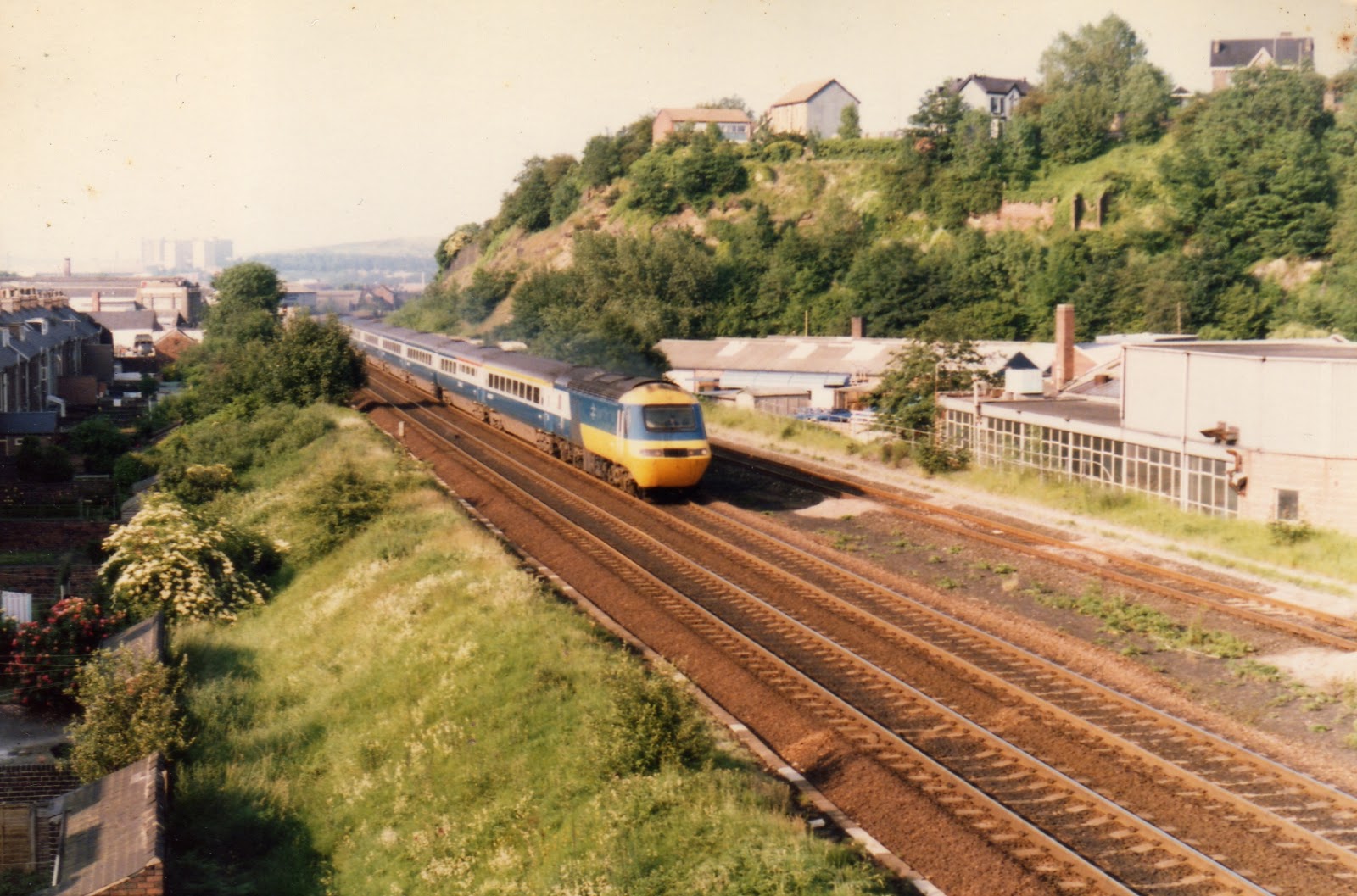
Intercity 125 at Woodseats, Sheffield, 1985
This photograph was taken on the very pleasant evening of the 2nd September, 1985. It shows the view northwards from the Woodseats Road bridge towards Sheffield city centre. The now demolished Norfolk Park flats can just be seen in the background. A London bound Inter City 125 is in the foreground. At this time, trains ran hourly to London in the early evening with the last departure leaving Sheffield at about 8.30 pm.
Subscribe to:
Posts (Atom)