Richard Marsh is mainly remembered, today, for his gothic horror novel, “The Beatle“. However, he wrote many entertaining short stories in addition to his longer more surreal tales. One of my favourites is “Aunt Jane’s Jalap”.
I have to admit that when I began reading this story I would not have known a jalap if it had slapped me round the face, bowed and formally introduced itself. A quick perusal of the Oxford dictionary informed me that a jalap was a purgative made from a Mexican vine of the genus Ipomoea purga. So there you are. I am a little better informed about the flora of central America than before I started to read the book.
Quack medicines, of course, were very popular in the Victorian age. There were virtually no controls on the claims that could be made for “medicines” of even the most dubious provenance. Into this questionable market, Mr Hughes and the narrator, George Lucas, decide to launch their own restorative, “Aunt Jane’s Jalap”.
The name, “Aunt Jane’s Jalap” was dreamt up by our two would be entrepreneurs. Hughes decided to use the name of his old nurse as such a title was likely to be trusted by elderly nineteenth ladies. It was questionable if anyone would buy a product bearing the name of the gentlemen to whom we are introduced.
Mr Hughes and Mr Lucas decide they need testimonials for their new cure-all. They decide to introduce “Aunt Jane’s Jalap” at a dinner party to be held with George’s lady friend, Margaret, her aunt Mrs Chalmers and a mutual friend, Mr Pybus. Pybus rapidly proves himself a most sarcastic character and a good judge of the merits of the new concoction.
During the course of the dinner, George raises the subject of the jalap and its supposed virtues. Pybus makes a series of entertaining and disparaging comments about the effectiveness of the remedy. After a while, a bottle of the jalap is produced and measures poured for the four people present. Despite the serious reservations of Mrs Chalmers and Mr Pybus, a full glassful is imbibed by all. The effects are immediate and unfortunate for the assembled party as discomfort and illness rapidly take hold.
The unpleasant effects of drinking the jalap rapidly become more pronounced. George asks Mrs Chalmers if there is anything he can do for her in her discomfort. Pybus mischievously suggests that he fetches another bottle of the remedy.
At this unfortunate juncture, Hughes re-enters the story. He accosts George and informs him that he may have given him a bottle of laudanum by mistake instead of the jalap. Both become very alarmed, as one might expect, at the prospect of a wine glass of poison being quaffed by everyone present. Doctors are called and in the meantime George tries to get the ladies to dance to maintain their circulation and to keep their spirits up. This ruse meets with only limited success.
Various doctors make their appearance and after adding to the comedy, they eventually cure the patients. George coolly observes that the servant charged with seeking a doctor had “fetched as many as he could. There were not one or two, but several. I have their bills.”
At the end of the story, the doctors inspect the offending bottle and rapidly notice that it does not smell of laudanum. Hughes realises that he has made another mistake and has inflicted a horrendous regime of Victorian treatment on everyone for no reason at all. The bottle did contain jalap but it was one of Hughes’s incorrectly measured test samples of jalap rather than the final product that he had given to George by mistake.
There is no record of whether the assembled party gives “Aunt Jane’s Jalap” a positive testimonial but it would seem unlikely.
I have attempted to outline the main details of the story in this article but have probably failed to convey the humour that Richard Marsh manages to write into the tale. I would thoroughly recommend “Aunt Jane’s Delap” as an entertaining short story written by a very underrated author. The tale is one of a collection of stories entitled “Amusement Only” and can be found on Project Gutenberg at http://www.gutenberg.org/ebooks/38188
Monday, 21 January 2013

Saturday, 5 January 2013
Oakhill, Horsham: The 1970s and Now
On the last Saturday of every November, Collyers school stages a reunion for former pupils. Despite moving to Sheffield from Horsham in 1981, I have become a regular attendee at this most enjoyable annual event. My most recent visit prompted me to wonder how my old route to school from my former home on Comptons Lane had changed since the 1970s. My visits for the reunion had never involved travelling any further than the short walk from the Station Hotel down Hurst Road to Collyers.
The Sunday morning after the annual reunion saw me setting off from the Station hotel on my journey, suitably reinvigorated by the hotel’s “Eat as much as you like breakfast”. Dodging the traffic and the persistent drizzle, I entered the station.
I suppose I shouldn’t have been surprised but the station itself had been transformed. Gone was the Henfield Taxi office and in its place was a much larger concourse complete with electronic departure boards and places to eat and drink. The dividing fence and the ticket collector’s office on the bridge had also been removed and it was necessary to negotiate an electronic ticket barrier at the Station Road entrance. Fortunately, this barrier was open as I had no ticket to present to the machine or to any enthusiastic ticket collector.
In the 1970s, a concrete panel wall was sited to the right of the entrance. This prevented any view of the station. It was good to see that this had been removed and replaced with railings which afforded a view of the station and gave the area a much more open appearance. A series of cycle racks were now in evidence - Perhaps indicative of a more health conscious age or a sign that the service on the Horsham - Oakhill circular bus route is even more irregular than it had been thirty five years ago.
The first disappointment of my walk was to see that the old newsagent on Station Road had been converted into a house. Unfortunately, the disappearance of most of the shops that I so fondly remembered from my childhood will become a feature of this story. In the meantime, there was some good news in that the external appearance of the Bedford Hotel was a lot more inviting than the stark and undecorated facade of days gone by.
Trudging on in the rain, I reached the junction of Barrington road and New Street. The delightful bakery on Barrington Road had gone to be replaced by a wine shop. I still have fond memories of the cakes and rolls that I bought in the old bakery during the long summer holidays.
My next port of call was Oakhill Road itself. One of the Baptist chapels had permanently closed its doors and the chemist had been extended into the former sweet shop at the corner of Burford Road. I was beginning to wonder where a boy or indeed a man of 49 years was supposed to buy sweets in Oakhill these days. No worries, I thought - It was not far to Oakhill Stores.
The junction of Elm Grove and Oakhill Road was soon reached but no Oakhill Stores was to be seen. Yet again, I was presented with another residential property. It was almost impossible to believe that this had once had been a popular convenience store. At one time, I recall there was a cigarette machine outside the shop which tempted schoolboys with the delights of ten Piccadilly and ten Number 6.
By this stage, I had become a little downhearted by the loss of so many shops in the area. It came as no great surprise when I found the two former adjoining shops on Highlands Road had also undergone the inevitable conversion to residential properties. Probably all these corner shops could not compete with the supermarkets but it made me a little sad to think that the children of today could not just pop round the corner for a bottle of Corona lemonade or two ounces of chocolate limes.
The final part of my nostalgic journey was the stretch up Highlands road to Comptons Lane. Today, this was a pleasant stroll but back in the 1970s it was bandit country for Collyers school boys. It would be fair to say that there was no much love lost between the pupils of Collyers and the Forest schools. I was regularly on the receiving end of taunts such as the very unoriginal “Collysprout” which appeared to be the favourite cry of some of the Forest lads when a Collyers boy came into sight. For the most part, there was no serious trouble but I was always glad when the two Forest schools were behind me and home was in sight.
Home was in Comptons Lane and I spent a few moments looking at the place which held so many memories. Much had changed but the concrete drive that I had helped my dad lay in the seventies was still there. After all these years it was spalling a little at the edges but then I suppose so am I.
Wednesday, 19 December 2012
3 car DMU at Woodseats, Sheffield, 1985
.JPG)
This picture, taken in September 1985 at Woodseats, shows a three car diesel multiple unit heading north towards Sheffield. This was the Chesterfield - Dronfield - Sheffield service. At this time, Dronfield only had a limited range of direct services. Today, Dronfield is served by an hourly service from Nottingham to Leeds and vice versa.
Tuesday, 18 December 2012
Intercity 125 at Woodseats, Sheffield, 1985
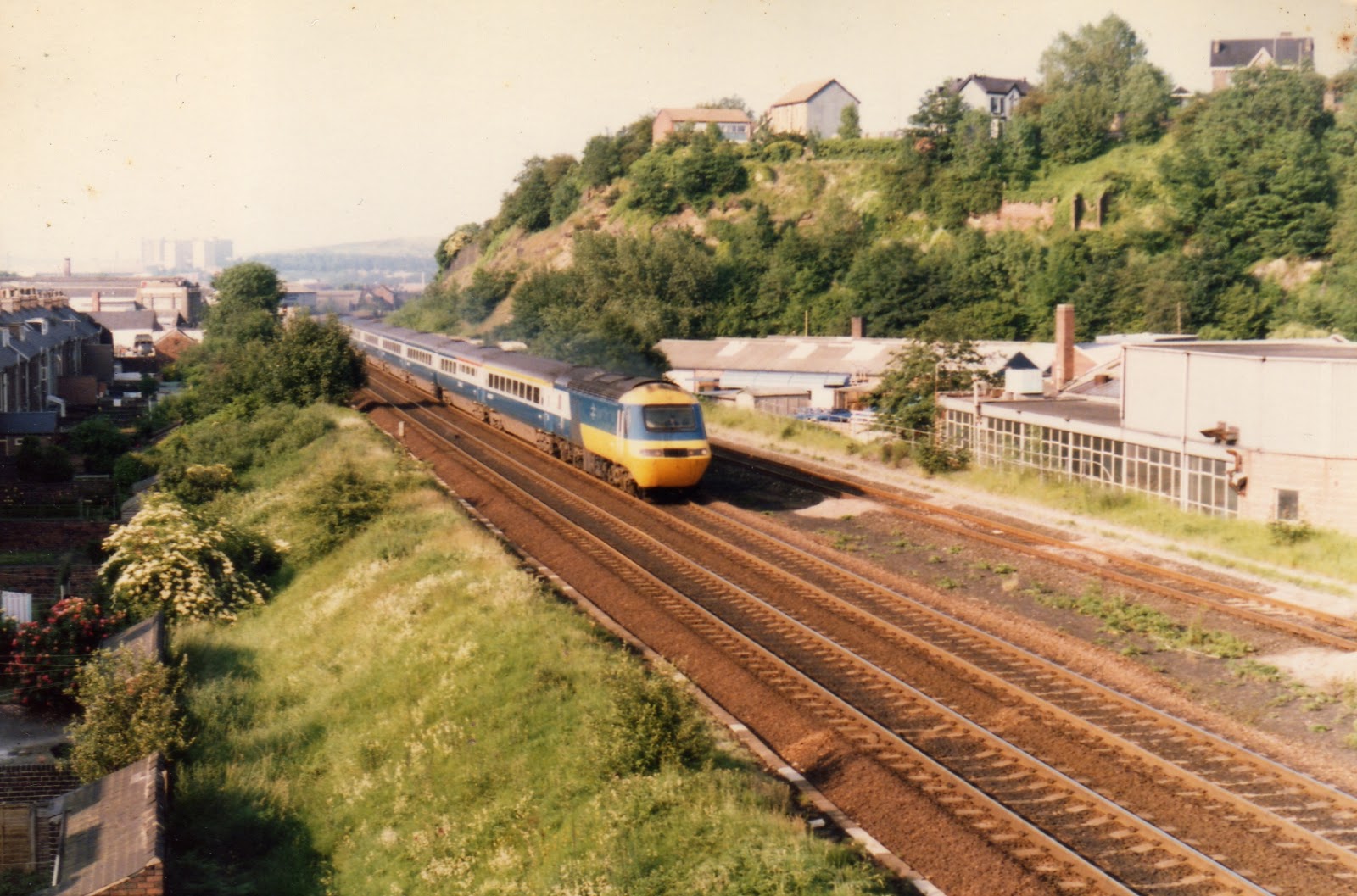
This photograph was taken on the very pleasant evening of the 2nd September, 1985. It shows the view northwards from the Woodseats Road bridge towards Sheffield city centre. The now demolished Norfolk Park flats can just be seen in the background. A London bound Inter City 125 is in the foreground. At this time, trains ran hourly to London in the early evening with the last departure leaving Sheffield at about 8.30 pm.
Saturday, 8 December 2012
Inside Billingshurst signal box, 1977
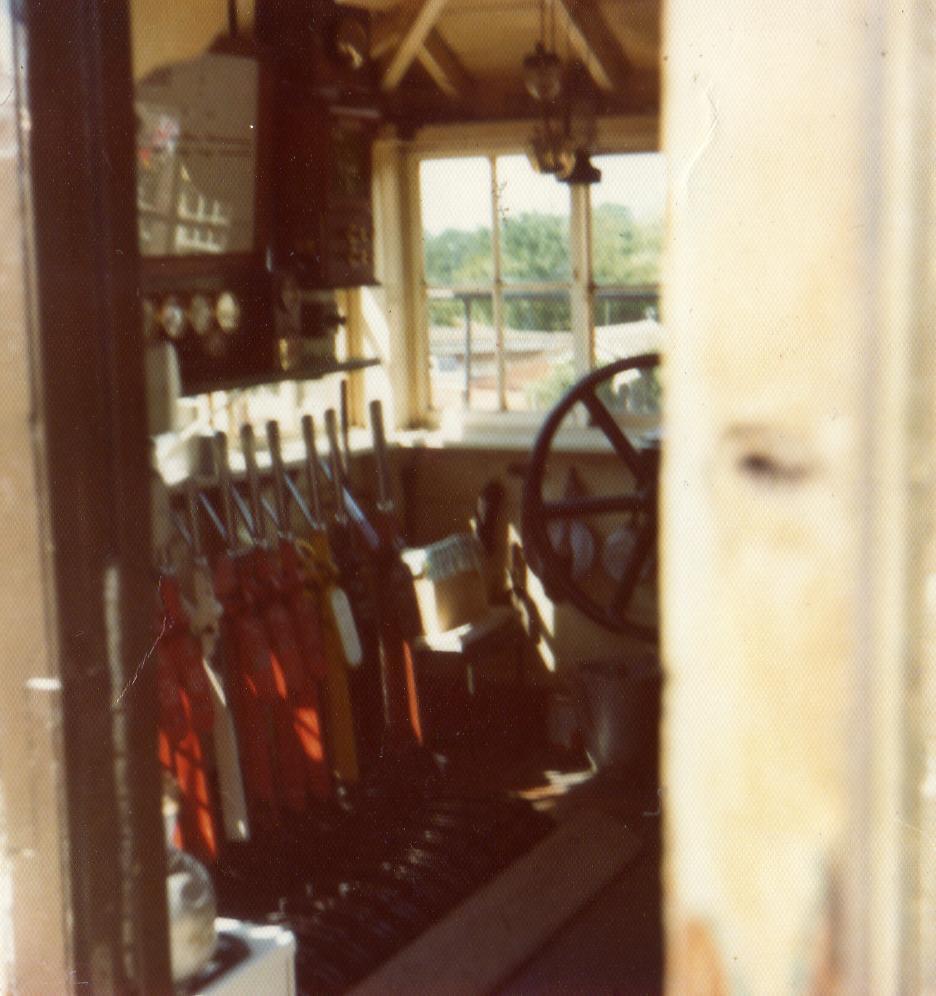
This photograph, taken in 1977, shows the inside of the signal box at Billingshurst. I understand that the signal box dates from the 19th century and that it is still in use today. A detailed description of the signal box and a photograph showing its external appearance can be found at http://www.signalbox.org/gallery/s/billingshurst.php
Saturday, 1 December 2012
Warnham station in 1976

This somewhat grainy photograph was taken in the autumn of 1976. Despite the quality of the picture, the signal box, crossing, signal and the canopy over the down line platfrom can be clearly seen. Sadly, all of these features have long since gone.
For a view of Warnham station taken from the platform in 1980, please follow this link:
Wednesday, 28 November 2012
Warnham station in 1980

This photograph was taken one summer evening in 1980. At this time, the down line platform still had a roof and the level crossing and the signal box were still in use. In 1980, trains only served Warnham in the morning and evening rush hours. There was a train once every half hour in each direction with one train an hour going to Waterloo and one to Victoria. All the downward journeys terminated at Horsham. The most noticeable thing about the station was the almost complete absence of passengers. On average, only one or two people would get on or off each train. I remember asking the signalman once how many tickets he had sold during his shift. I was informed that over the shift, he had only sold one single to Horsham. It is perhaps surprising that the station stayed open. Today, the level of service is slightly better but the appearance of the station has somewhat deteriorated.
For a photograph of Warnham station taken from the road in 1976, please follow this link:
Subscribe to:
Posts (Atom)